

Welcome to Amanda's NICU Education



RNC-NIC Exam Prep & NICU Education for Nurses
I'm Amanda, a neonatal Clinical Nurse Specialist, NICU educator, and NICU nurse who's been caring for critically ill newborns since 2009.
I currently work as a Clinical Nurse Specialist in a Level IV NICU in Los Angeles, where I support neonatal nurses, providers, and families through education, evidence-based practice, and clinical expertise.
I created Amanda's NICU Ed to make high-quality NICU education more approachable and to help nurses feel more confident at the bedside and prepared for the RNC-NIC exam.
NICU Education for Nurses at Every Stage
Whether you're preparing for the RNC-NIC, starting your career in the NICU, or looking to strengthen your neonatal nursing knowledge, Amanda's NICU Ed provides practical, evidence-based education designed specifically for NICU nurses.
RNC-NIC Exam Prep
Prepare for the RNC-NIC with focused review materials, study resources, and practical test-taking strategies.

NICU Education
Build your knowledge and confidence with approachable education covering the concepts NICU nurses use every day.

NICU Resources
Find study guides, books, free resources, and educational content to support your growth as a neonatal nurse.

Not very many people love taking tests but as a self-acclaimed "forever student" who has taken (and passed) five different certification exams I am no longer afraid of tests! "Way to brag", you might be thinking but I want to help YOU pass your certification exam too!
Introducing Amanda's RNC-NIC Success digital course - your ultimate study companion!
Gain unlimited, on-demand access for life, ensuring you're primed to ace your certification exam.
I'm here to help you succeed and I can't wait for you to share with me that you PASSED the RNC-NIC EXAM!!!

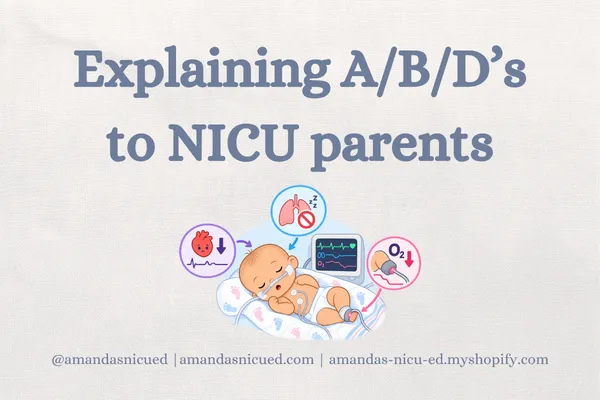
How to explain A/B/D's to NICU Families
How to Explain Apnea, Bradycardia, and Desaturation to NICU Families (Without Medical Jargon)
Every NICU Nurse Has Been Asked…
"Did my baby stop breathing?" "Did my baby almost die?" "Will this cause brain damage?" "Why does this keep happening?"
Few moments are more frightening for a parent than watching alarms sound while nurses quickly gather around their baby's bedside. Even if the event resolves within seconds, it can leave families feeling terrified and confused.
As NICU nurses, one of our most important jobs isn't just responding to apnea, bradycardia, and desaturation events, it's helping families understand why they happen.
The challenge? We understand the physiology. Parents don't.
Let's bridge that gap.
First, Understand the Physiology Yourself
Before we can explain it simply, we need to understand what's happening.
A/B/D events involve three interconnected problems:
Apnea: a pause in breathing
Desaturation: oxygen levels in the blood fall
Bradycardia: the baby's heart rate slows
These don't always happen in the same order. Some babies desaturate first, then experience bradycardia, then apnea follows. Others begin with a breathing pause. The sequence depends on the baby and what triggered the event.
However, in premature infants, this common pattern is typical: Immature respiratory center in the brain → Pause in breathing → Less oxygen entering the lungs → Oxygen saturation falls → Heart rate slows
Understanding that sequence helps nurses explain what families are seeing, while also recognizing that each baby may be slightly different.
Why Does This Happen?
Premature babies aren't forgetting to breathe because something is "wrong" with them.
They're forgetting because the part of the brain responsible for automatically regulating breathing is still immature.
Imagine a smartphone with a software update that's only halfway installed. Most of the time it works fine, but occasionally it freezes for a few seconds before catching up.
A premature baby's breathing control center behaves similarly. The system works, but it's still learning to function consistently. It's also more easily triggered to pause by things like temperature changes, position shifts, or even being handled during a diaper change.
Important note: Not all A/B/D events are simply "apnea of prematurity." Some babies have underlying causes including infection, heart issues (like patent ductus arteriosus), anemia, gastroesophageal reflux, or other conditions. These can make events worse or more frequent. If events seem excessive or are getting worse rather than improving, the NICU team will investigate these possibilities.
As the brain matures over the following weeks (typically by 36–37 weeks corrected age), these pauses become less frequent until they disappear altogether. Some babies may need caffeine therapy to help speed this maturation.
Here's How I'd Explain It to Parents
Instead of saying: "Your baby had an apnea and bradycardic event."
Try something like this: "Your baby's brain is still learning to control breathing automatically. Every once in a while it takes a brief pause before remembering to take the next breath. When that happens, their oxygen level can drift down, and because babies' hearts are very connected to their breathing, their heart rate may slow for a short time too. Most babies recover on their own or with a little gentle reminder, like a light touch."
Notice what this explanation does:
It avoids jargon.
It explains the sequence of events.
It normalizes the developmental immaturity.
It reassures parents that there is a reason this is happening.
Understanding "Normal" Breathing Pauses vs. A/B/D Events
Parents often worry when they notice their baby's breathing is irregular. Here's an important distinction to explain:
Periodic breathing is normal in premature babies. They'll breathe regularly for a few seconds, then pause for 5-10 seconds, then start again. This is not an A/B/D event because the baby's oxygen level stays stable and heart rate doesn't drop.
An A/B/D event is different because the baby's oxygen level does drop, the heart rate slows, and it requires intervention or close monitoring.
Clarifying this difference helps parents understand they don't need to be alarmed every time their baby's breathing looks unusual.
Why Does Gentle Stimulation Work?
Parents often wonder why simply rubbing their baby's back seems to solve such a frightening event.
You might explain it like this: "Think about someone who's dozing off on the couch. If you gently tap their shoulder, they'll take a deeper breath and wake up a little. That's similar to what we're doing. A gentle touch reminds your baby's brain to restart that breathing pattern."
Simple stimulation increases alertness enough for the breathing center to resume its normal rhythm.
Teaching Parents to Help: Many parents want to know: "Can I help my baby during these events?" The answer is often yes, but with guidance:
Show them how to gently rub or tap the baby's back or foot
Explain that a light touch works better than aggressive stimulation
Clarify when not to stimulate (if the baby is already breathing well)
Let them know that stimulation is helpful and that our assessment and monitors will alert us if anything more is needed
This small teaching empowers parents and helps them feel like active participants in their baby's care rather than helpless bystanders.
Why Do These Events Happen More During Feeding?
Another common question is: "Why does this happen almost every time we feed?"
Feeding is surprisingly hard work.
Adults rarely think about it, but babies have to:
suck,
swallow,
breathe,
all while protecting their airway.
Premature infants are still developing this coordination. Additionally, feeding increases the work of breathing and metabolic demand on an already immature system.
A simple explanation might be: "Imagine trying to drink from a straw while running up a flight of stairs. You'd probably need to stop and catch your breath. Feeding can feel that challenging for premature babies. As they grow and mature, that coordination gets stronger."
What You Can Do: Help parents understand that paced feeding (letting the baby control the pace, taking breaks) can help reduce events. Temperature stability and minimizing handling during and around feeds also matter.
Questions Parents Often Ask
"Did my baby stop breathing?"
A brief pause in breathing can occur, but many episodes are short and resolve quickly. It's important to explain that NICU staff continuously monitor babies so these events are recognized and managed promptly.
You might add: "We watch your baby's heart rate and oxygen level continuously on these monitors. If we see an event starting, we're right there, and your baby usually recovers quickly, either on their own or with a gentle touch."
"Will this hurt my baby's brain?"
This is often the question parents are most afraid to ask.
You might respond: "Brief events that resolve quickly within 10-20 seconds with oxygen levels that don't drop too far are not expected to cause brain injury. What matters most is how often events are happening and how low the oxygen level goes. We watch closely because we want to prevent prolonged episodes and make sure your baby is recovering appropriately."
Avoid giving absolute guarantees, but provide appropriate reassurance while acknowledging that the care team monitors the frequency and severity of events. If your baby is having many clustered events (multiple events within hours), the risk of cumulative oxygen fluctuations increases, which is why treatment becomes important.
"If my baby is on caffeine, does that mean something is wrong?"
Many families hear "caffeine" and may feel confused or concerned. Explain it simply: "Caffeine helps stimulate your baby's breathing center; kind of like a gentle nudge that helps their brain mature faster. It's a common, safe medication that helps babies who have frequent apnea. Babies outgrow the need for it before discharge."
"Will my baby outgrow this?"
For apnea of prematurity, the answer is usually yes.
As the nervous system matures, these events become less frequent until they stop altogether. That's one reason NICUs often require babies to remain free of significant apnea or bradycardia events for a period (typically 24-48+ hours, depending on the protocol) before discharge.
However, be honest about discharge scenarios: "Some babies go home with oxygen and a monitor so we can make sure the events have truly stopped. This doesn't mean your baby isn't ready, it just means we're keeping a close eye on their breathing a little longer."
Environmental Triggers: What Families Can Do
Help families understand they have some control over events by managing triggers:
Keep baby warm: Cold stress increases apnea risk
Pace feeds: Let baby control the pace; offer rest breaks
Minimal handling: Cluster cares when possible; avoid unnecessary waking
Good positioning: Making sure the airway is open and not obstructed.
Monitor for illness: Infections are a common trigger
Knowing they can reduce events through environmental management helps parents feel empowered rather than helpless.
Things to Avoid Saying
❌ "It's normal." Parents may feel dismissed. Instead try: "It's common in premature babies because their breathing control center is still developing."
❌ "Don't worry." Instead: "I know that was scary to watch. Let me explain what happened." Acknowledging emotion before explaining physiology builds trust.
❌ "They just forgot to breathe." While commonly used among clinicians, families may interpret this literally and imagine their baby can simply stop breathing at any moment. A more complete explanation helps: "Their brain is still learning to keep breathing automatic all the time. That's why we're here monitoring and helping."
❌ "Everything is fine" (after a significant event). Instead: "That event is exactly why we monitor so closely. Your baby recovered beautifully, and here's what happened and why."
In Summary
One of the greatest gifts we can give NICU families isn't just excellent clinical care, it's understanding.
When parents understand why apnea, bradycardia, and desaturation events happen, when they know what's normal periodic breathing versus a true event, when they understand the timeline for improvement, those alarms become a little less mysterious and a little less terrifying. Every clear, compassionate explanation helps replace fear with confidence and strengthens the partnership between families and the NICU team.
The most powerful message you can send? "This is scary to watch, and it's completely normal to feel frightened. But your baby's body is doing exactly what it's supposed to do: learning and growing. And we're here every step of the way."
Amanda's Teaching Tip 💜
Before explaining any NICU condition, ask yourself: "If I had no medical background, would this explanation make sense?" "What would I be most afraid to ask?" "What practical information would actually help me feel more confident?"
The best NICU educators don't simplify the science, they translate it. They also acknowledge the fear before launching into physiology. That's how we empower families and build trust, one conversation at a time.
Ready to Feel More Confident Explaining the "Why"?
One of the most rewarding parts of being a NICU nurse is helping families understand what's happening with their baby. But it's hard to explain something simply if you don't fully understand the physiology yourself.
That's exactly why I created my RNC-NIC & CCRN-N Certification Review Course. It's more than a test prep course. It's designed to help you truly understand neonatal physiology so you can think critically at the bedside, anticipate changes in your patients, and confidently explain complex concepts to families in a way they can understand.
Whether you're studying for certification or simply want to become a stronger, more confident NICU nurse, I'd love to help you get there.
💜 Ready to deepen your understanding of neonatal physiology? Learn more about the Certification Review Course and join thousands of NICU nurses who have strengthened their knowledge, confidence, and bedside practice.

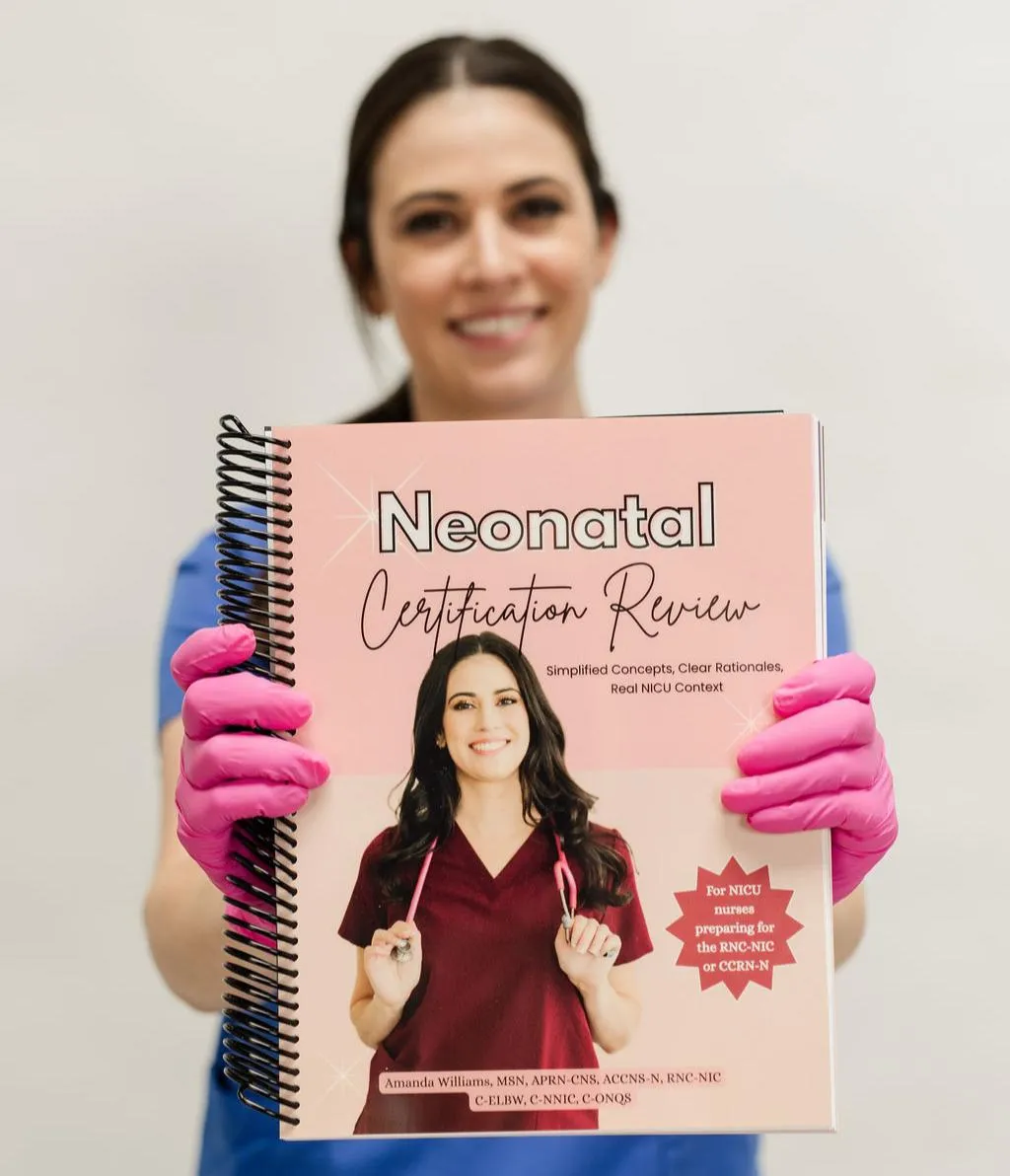
NEONATAL CERTIFICATION
REVIEW BOOK
📌 What’s Inside:
- 13 comprehensive chapters covering core NICU certification content
- Clear, organized breakdowns for fast recall
- Peer-reviewed to ensure clinical accuracy and depth
- Ideal for RNC-NIC or CCRN-N prep — or as a reference guide for NICU nurses at any level
- Plenty of space to write in and take notes
📚Table of Contents:
- Maternal Health & Birth History
- Intrauterine to Extrauterine Transition
- Neonatal Resuscitation
- Thermoregulation
- Neurologic System
- Respiratory System
- Oxygen, Ventilation, & Acid-Base Balance
- Cardiovascular System
- Nutrition & Feeding
- Hematopoietic System
- Infection & Immunology
- Professional Practice
Ready to kickstart your journey to becoming a certified NICU nurse?
Look no further!
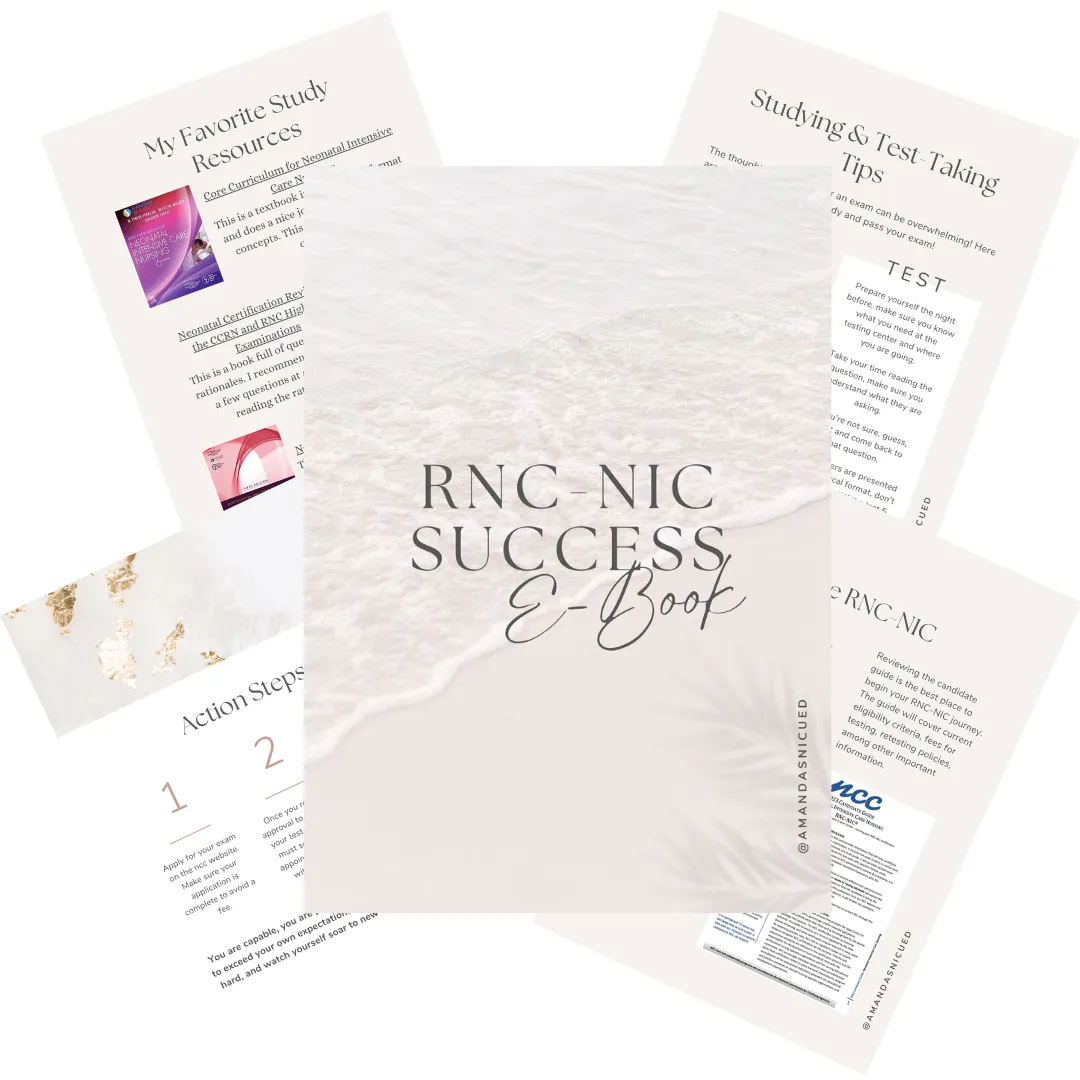
Grab my FREE E-Book packed with essential study and test-taking strategies for the RNC-NIC.
In the E-Book I give you the resources you need including the link to access the candidate guide, several types of books to study from, some of my favorite strategies, an outline of the content you should review, and a blank calendar for you to make your study plan!
Frequently Asked Questions About the RNC-NIC exam

What is the RNC-NIC?
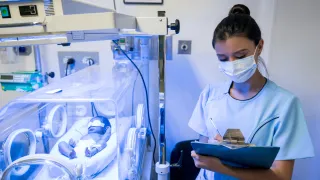
The RNC-NIC is a competency-based exam that tests the specialty knowledge of nurses in the United States & Canada who care for critically ill newborns and their families.
The RNC-NICU is a nationally recognized certification that recognizes the registered nurse for their specialty knowledge and skill.
Who can take the RNC-NIC exam?
Nurses can take this exam after a minimum of two years experience in the NICU caring for critically ill newborns and their families.

Which books should I use?
I'm glad you asked! There are many excellent books to help you prepare for the RNC-NIC, I gathered ande describe each of them for you in my FREE e-book.
Is there a course to help me study?
Yes! Many hospitals host their own certification course and there are a few online courses. See my RNC-NIC test taking tips E Book for more information
What happens if I don't pass the exam?
If you don't pass the exam on your first try you can try again after 90 days. You will have to reapply after 90 days and pay a retest fee. There is no limit to the number of times you can take the exam (however a candidate can only sit for the exam twice per year).
Can I make more money if I take the RNC-NIC exam and get certified?
Yes! Many hospitals provide a raise or a bonus for nurses with specialty certifications. Hospitals also typically hire at a higher base salary when nurses have a certification.

Find me @amandasnicued on these channels or Email me
hey nurses don't miss out
© Copyright 2024. AmandasNICUEd. All rights reserved. | Terms & Conditions | Privacy Policy Contact: [email protected]