

Welcome to Amanda's NICU Education


Hi! My name is Amanda. I'm a NICU nurse, Clinical Nurse Specialist, NICU Educator... basically your NICU BFF. If you want to talk NICU, I'm here for you! I love everything about NICU nursing and I'm eager to learn and share my knowledge with all my NICU friends.
I have been a NICU nurse since 2009 I am currently a Clinical Nurse Specialist in a Level IV NICU in Los Angeles.
I am passionate about educating the next generation of NICU nurses. I share my knowledge through platforms such as Instagram and Facebook and am excited to have you here on my website!
Click on the button below to sign up for my newsletter filled with NICU education and tips for all experience levels.

Not very many people love taking tests but as a self-acclaimed "forever student" who has taken (and passed) five different certification exams I am no longer afraid of tests! "Way to brag", you might be thinking but I want to help YOU pass your certification exam too!
Introducing Amanda's RNC-NIC Success digital course - your ultimate study companion!
Gain unlimited, on-demand access for life, ensuring you're primed to ace your certification exam.
I'm here to help you succeed and I can't wait for you to share with me that you PASSED the RNC-NIC EXAM!!!








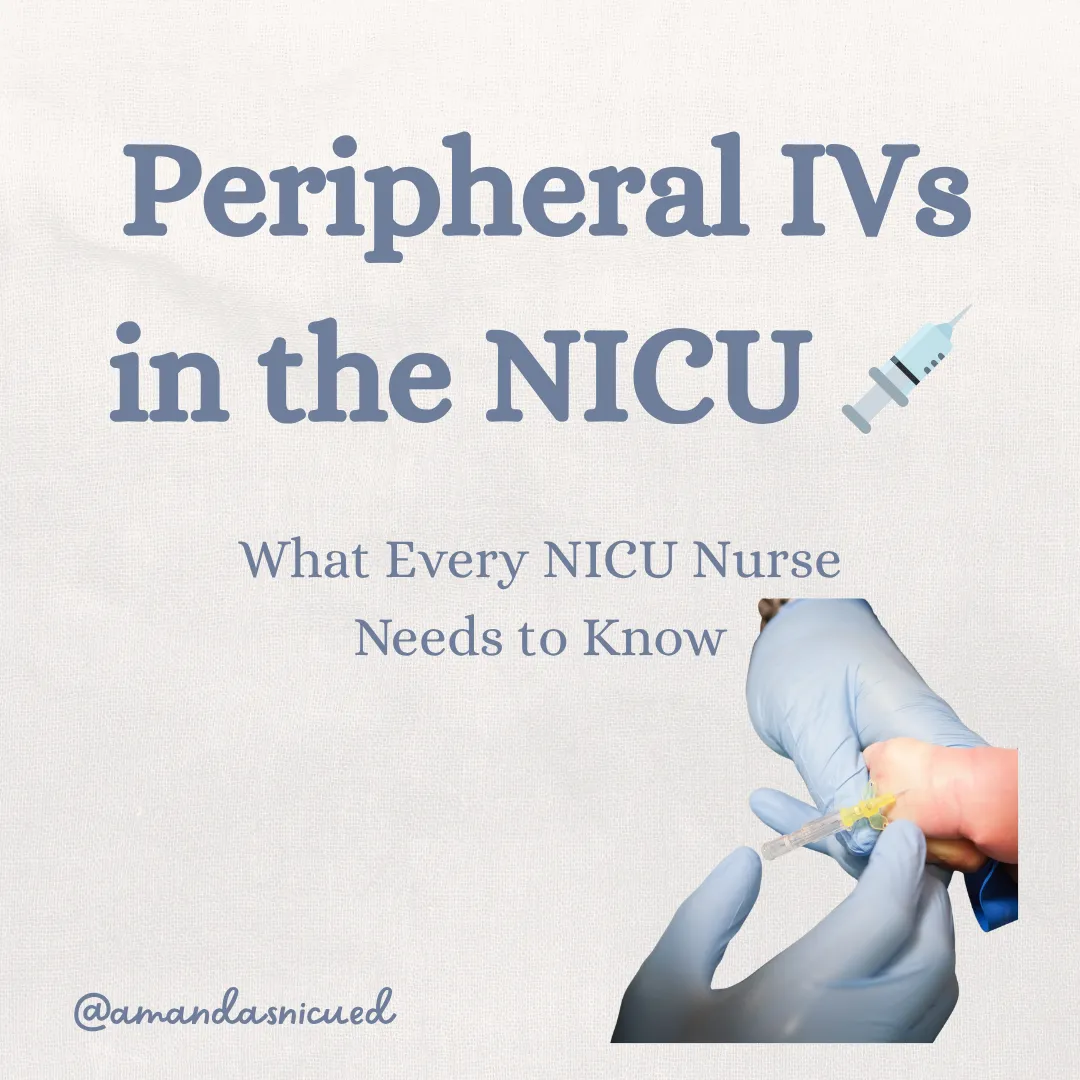
Vascular Access in the NICU: PIVs, PICCs, UVCs, UACs, and IO Access Explained
Vascular Access in the NICU: PIVs, PICCs, UVCs, UACs, and IO Access Explained
A Clinical Reference for NICU Nurses
Vascular access is one of the most common and important aspects of neonatal care. From peripheral IVs to umbilical catheters and PICC lines, we as NICU nurses rely on vascular access devices every day to deliver medications, fluids, nutrition, blood products, and lifesaving therapies.
Each device has unique benefits, limitations, and potential complications. Understanding why a particular line is chosen and what complications to monitor for helps nurses provide safer care and identify problems early.
Let’s review the most common vascular access devices used in the NICU, what nurses need to know about each one, and why catheter tip position matters more than you might think.
Peripheral Intravenous Catheters (PIVs)
Peripheral IVs are short catheters inserted into superficial veins and are often the first vascular access device placed in a NICU patient.
Common Uses
• Maintenance IV fluids
• Dextrose-containing fluids
• Short-term medications
• Short-term parenteral nutrition
• Blood products (per institutional policy)
Advantages
• Quick and relatively easy to place
• Less invasive than central lines
• Lower infection risk than central vascular access devices
Limitations
• Short lifespan
• Fragile neonatal veins requiring frequent restarts
• Increased risk of infiltration and extravasation
What Nurses Need to Watch For
Infiltration occurs when IV fluid leaks into surrounding tissue rather than remaining within the vein. Signs may include swelling, blanching, cool skin, leakage at the insertion site, or unexplained irritability in the infant.
✦ Clinical Pearl: The Flushing Myth
A peripheral IV can infiltrate and still flush easily. If a site appears swollen, blanching,
or otherwise concerning, do not assume the line is functional simply because it flushes
without resistance. When in doubt, take it out!

Extravasation occurs when tissue-damaging medications leak into surrounding tissue. Some of the high-risk infusates in the NICU include calcium-containing solutions, sodium bicarbonate, vancomycin, and certain vasoactive medications. These injuries can result in tissue necrosis and long-term scarring if not identified promptly. Continuous infusions should be assessed at minimum every hour, per most institutional policies.¹
Peripherally Inserted Central Catheters (PICCs)
PICCs are long catheters inserted through a peripheral vein with the tip terminating in a central vessel—ideally the lower third of the superior vena cava (SVC) for upper extremity insertions, or the upper inferior vena cava (IVC) for lower extremity insertions. The high blood flow in these vessels allows more concentrated solutions to be infused safely.
Common Uses
• Long-term parenteral nutrition (PN)
• Higher dextrose concentrations (>12.5%)
• Amino acid solutions
• Extended antibiotic therapy
• Vasoactive medications
• Infants with poor peripheral access
Benefits
• Longer dwell times with fewer painful restarts
• Reliable access for critically ill infants
• Ability to administer central-only therapies safely
✦ Clinical Pearls: PICC Tip Position
Ideal tip location: Lower third of the SVC (upper extremity), or upper IVC (lower extremity insertions).
Tip in the right atrium: Risk of arrhythmias and cardiac perforation. Pericardial effusion and cardiac tamponade, though rare, are life-threatening complications associated with intracardiac tip position.²
Tip too peripheral (not central): Loss of the high-flow dilution effect. Hypertonic solutions and TPN infused through a non-central tip can cause phlebitis, thrombosis, and chemical injury to smaller vessels.
Tip migration: PICCs can migrate with arm repositioning, positive pressure ventilation, and patient growth. A line correctly positioned on day 1 may not be correctly positioned on day 10. Clinical changes warrant reassessment of tip position.
Potential Complications
Phlebitis
Phlebitis is inflammation of the vein, most commonly occurring within the first several days after insertion. Signs include redness, warmth, tenderness along the vein tract, and sometimes a palpable cord. Causes may be mechanical, chemical, or infectious. Management typically includes warm compresses, provider notification, and in some cases line removal.
Central Line-Associated Bloodstream Infection (CLABSI)
CLABSI prevention is a major clinical priority in neonatal care. Extremely low birthweight infants are at especially high risk given immature immune defenses and prolonged line dwell times.³
Key bundle elements include:
• Clean, dry, and intact dressings at all times
• Aseptic technique for all line access
• Standardized tubing change intervals
• Daily evaluation of line necessity
• Skin care practices per gestational age and institutional guidelines
Thrombosis
Thrombus formation may occur around or within the catheter. Monitor for difficulty flushing, occlusion alarms, limb swelling, or changes in catheter function. When removing a PICC, resistance should never be met with force. If you meet resistance when removing a PICC line notify the provider and follow institutional protocol.
Tunneled Central Venous Catheters
Tunneled central lines (e.g., Broviac, Hickman) are surgically placed catheters designed for prolonged use in infants with intestinal failure, long-term TPN dependence, or complex chronic conditions. Nursing care mirrors PICC management and focuses on infection prevention, dressing integrity, aseptic access, and early complication recognition. These lines are precious: surgical placement often requires sacrificing a vessel, so every effort should be made to protect patency and prevent infection.
Umbilical Venous Catheters (UVCs)
UVCs provide central venous access through the umbilical vein and are often placed in the delivery room or shortly after admission. They are particularly valuable in the most premature and unstable newborns, where other forms of access are very challenging to establish quickly.
Common Uses
• Delivery room stabilization and resuscitation
• Fluids and Nutrition for extremely preterm infants at birth
• Asphyxiated infants undergoing therapeutic hypothermia
• Critically ill newborns requiring urgent fluid, medication, or blood product administration
• Parenteral nutrition and vasoactive infusions
Tip Position: Why It Matters for UVCs
In a UVC the catheter travels through the umbilical vein, into the portal system, through the ductus venosus, and ideally terminates near the junction of the inferior vena cava and right atrium (IVC-RA junction).
✦ Clinical Pearls: UVC Tip Position
Ideal tip location: IVC-RA junction, typically at the level of the diaphragm or just above (T8-T10 on chest X-ray is a commonly cited radiographic landmark).⁴
Low-lying UVC (tip in the portal system): High risk of hepatic injury, including portal vein thrombosis, hepatic necrosis, and calcifications. TPN and hypertonic solutions should NOT be infused through a low-lying UVC. Vasoactive medications infused into the portal circulation have caused hepatic necrosis.
Tip in the right atrium: Risk of arrhythmias, myocardial injury, and pericardial effusion. An intracardiac UVC should be repositioned promptly.
Low-lying UVCs in emergencies: In resuscitation, a low-lying UVC can be used briefly for emergency medications—but must not remain for ongoing infusions once the infant is stabilized.
UVC dwell time: To mitigate risks associated with infection and thrombosis, many NICUs prioritize the discontinuation of UVCs once alternative access is secured, typically within the initial seven days of life.
Potential Complications
• Infection / CLABSI
• Malposition (portal, hepatic, or cardiac)
• Portal and hepatic vein thrombosis
• Hepatic injury from infusate extravasation through malpositioned catheters
• Arrhythmias from intracardiac catheter position
• Pericardial effusion / cardiac tamponade
Nurses must remain vigilant for unexpected changes in clinical status—including sudden bradycardia, hypotension, or respiratory deterioration—that may indicate catheter migration or a cardiac complication.
Umbilical Arterial Catheters (UACs)
UACs provide direct arterial access through an umbilical artery into the aorta, offering continuous hemodynamic monitoring and frequent blood sampling without repeated painful arterial sticks.
Benefits
• Continuous real-time blood pressure monitoring
• Frequent blood gas and laboratory sampling without procedural pain
Tip Position: Why It Matters for UACs
In the UAC, the catheter enters an umbilical artery, travels down through the internal iliac artery, and back up the aorta.
✦ Clinical Pearls: UAC Tip Position
Two accepted tip positions:
High position: T6–T10 (above the celiac, superior mesenteric, and renal arteries)
Low position: L3–L5 (below the renal arteries, above the aortic bifurcation)
The difference: High-position UACs are generally preferred at many institutions due to lower rates of vascular complications, but practice varies by unit.
The danger zone: Tips resting at T11–L2 sit at the level of the celiac trunk, superior mesenteric artery, and renal arteries. A catheter tip here increases the risk of thromboembolism to these critical vessels, potentially causing gut ischemia or renal injury.⁷
NEC and intestinal blood flow: Historically there has been concern regarding altered mesenteric blood flow and NEC risk in infants with UACs. While current evidence has not consistently demonstrated an increased risk of NEC, nurses should continue to monitor feeding tolerance and abdominal assessment findings closely.
Potential Complications
Vasospasm
Catheter presence within the arterial system can cause vessel irritation and vasospasm. Signs include blanching, pale extremities, cool toes, delayed capillary refill, and poor perfusion. Notify the provider immediately and follow institutional protocol. Some units place a warm pack on the contralateral extremity to promote reflex vasodilation—check your institution’s guidelines.
Thrombosis
Arterial thrombus formation is a serious concern with UACs. Monitor for decreased urine output (suggesting renal artery involvement), changes in blood pressure, poor lower extremity perfusion, cool or discolored extremities, and diminished pulses. Prompt recognition is critical to preventing ischemic injury.
Intraosseous (IO) Access
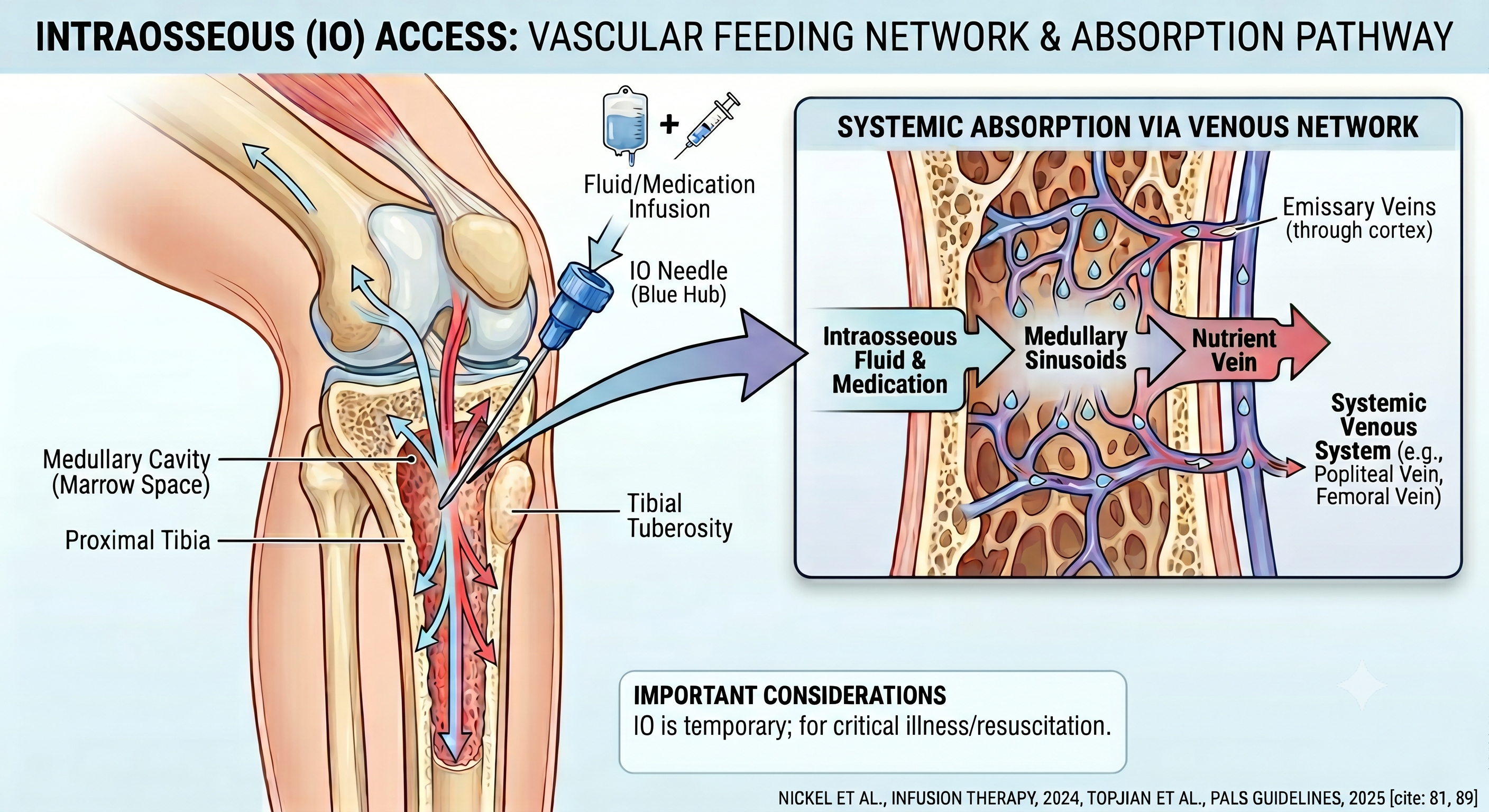
Though less commonly used in the NICU than in other emergency settings, IO access is an important option every NICU nurse should understand. An IO needle is inserted directly into the bone marrow space, providing rapid delivery of medications and fluids when vascular access cannot otherwise be quickly established.
When Is IO Considered?
• Patient is critically ill or undergoing active resuscitation
• IV access cannot be obtained rapidly
• Immediate medication or fluid delivery is required
What Can Be Given Through IO?
Almost anything that can be given IV can also be given IO, including fluids, blood products, epinephrine, and other emergency medications.⁸
Common Insertion Sites
The proximal tibia (just below the tibial tuberosity) is the most common site. Additional sites may be used depending on institutional protocol and available equipment.
Important Considerations
IO is a temporary measure. The goal is to stabilize the patient while more definitive vascular access is established. Every NICU nurse should know where IO equipment is stored, how it functions, and their role during insertion and ongoing management. In a true emergency, that familiarity can save critical seconds.
The Bottom Line
Every vascular access device in the NICU serves a specific purpose. Understanding the advantages, limitations, and complications of each line allows nurses to make thoughtful assessments, recognize problems early, and advocate for patient safety.
And when it comes to central lines (UVCs, UACs, and PICCs) tip position is a clinical priority. A line in the wrong position is not a functioning central line; it’s a potential source of serious, preventable harm.
Whether you’re monitoring a PIV for extravasation, protecting a PICC from infection, assessing a UAC for signs of vasospasm, or assisting with an emergency IO placement, your assessment skills are often the first line of defense against serious complications.
The most important question isn’t simply, “Does this line work?”
It’s, “Is this line safe for my patient?”
Ready to take your NICU knowledge to the next level?
If you found yourself nodding along to this post…or maybe you recognized there are gaps you want to fill—that's exactly what my certification review course is built for.
The RNC-NIC and CCRN-N exams test the kind of clinical reasoning we've been talking about here: not just what the complication is, but why it happens, how to catch it early, and what to do about it. My course is designed to help you think through the material the same way you think at the bedside.
References
1. Nickel, B., Gorski, L., Kleidon, T., Kyes, A., DeVries, M., Keogh, S., Meyer, B., Sarver, M. J., Crickman, R., Ong, J., Clare, S., & Hagle, M. E. (2024). Infusion therapy standards of practice, 9th edition. Journal of Infusion Nursing, 47(1S), S1-S285. doi.org
2. Wang, J., Wang, Q., Liu, Y., Lin, Z., Janjua, M. U., Peng, J., & Du, J. (2022). The incidence and mortality rate of catheter-related neonatal pericardial effusion: A meta-analysis. Medicine, 101(47), e32050. https://doi.org/10.1097/MD.0000000000032050
3. Schulman J, Stricof R, Stevens TP, et al. Statewide NICU central-line-associated bloodstream infection rates decline after bundles and checklists. Pediatrics. 2011;127(3):436–444.
4. Hoellering AB, Koorts PJ, Cartwright DW, Davies MW. Determination of umbilical venous catheter tip position with radiograph. Pediatr Crit Care Med. 2014;15(1):56–61.
5. Ramasethu, J., & Seo, S. (2020). MacDonald’s atlas of procedures in neonatology (6th ed.). Wolters Kluwer..
6. Barrington KJ. Umbilical artery catheters in the newborn: effects of position of the catheter tip. Cochrane Database Syst Rev. 1999;(1):CD000505.
7. Gomella, T, L. et al (2020). GOMELL'S Neonatology: Management, Procedures, On-Call Problems, Diseases, and Drugs (Eight Edition).
8. Topjian, A. A., et al. (2025). Part 8: Pediatric advanced life support: 2025 American Heart Association and American Academy of Pediatrics guidelines for cardiopulmonary resuscitation and emergency cardiovascular care. Circulation, 152(16_suppl_2), S479–S537. doi.org


December 2023 Certification Review Webinar
NICU Certification Review

Ready to kickstart your journey to becoming a certified NICU nurse?
Look no further!
Grab my FREE E-Book packed with essential study and test-taking strategies for the RNC-NIC.
In the E-Book I give you the resources you need including the link to access the candidate guide, several types of books to study from, some of my favorite strategies, an outline of the content you should review, and a blank calendar for you to make your study plan!
Frequently Asked Questions About the RNC-NIC exam

What is the RNC-NIC?
The RNC-NIC is a competency-based exam that tests the specialty knowledge of nurses in the United States & Canada who care for critically ill newborns and their families.
The RNC-NICU is a nationally recognized certification that recognizes the registered nurse for their specialty knowledge and skill.

Who can take the RNC-NIC exam?
Nurses can take this exam after a minimum of two years experience in the NICU caring for critically ill newborns and their families.

Which books should I use?
I'm glad you asked! There are many excellent books to help you prepare for the RNC-NIC, I gathered ande describe each of them for you in my FREE e-book.
Is there a course to help me study?
Yes! Many hospitals host their own certification course and there are a few online courses. See my RNC-NIC test taking tips E Book for more information
What happens if I don't pass the exam?
If you don't pass the exam on your first try you can try again after 90 days. You will have to reapply after 90 days and pay a retest fee. There is no limit to the number of times you can take the exam (however a candidate can only sit for the exam twice per year).
Can I make more money if I take the RNC-NIC exam and get certified?
Yes! Many hospitals provide a raise or a bonus for nurses with specialty certifications. Hospitals also typically hire at a higher base salary when nurses have a certification.

Find me @amandasnicued on these channels or Email me
hey nurses don't miss out
© Copyright 2024. AmandasNICUEd. All rights reserved. | Terms & Conditions | Privacy Policy Contact: [email protected]