

Welcome to Amanda's NICU Education



RNC-NIC Exam Prep & NICU Education for Nurses
I'm Amanda, a neonatal Clinical Nurse Specialist, NICU educator, and NICU nurse who's been caring for critically ill newborns since 2009.
I currently work as a Clinical Nurse Specialist in a Level IV NICU in Los Angeles, where I support neonatal nurses, providers, and families through education, evidence-based practice, and clinical expertise.
I created Amanda's NICU Ed to make high-quality NICU education more approachable and to help nurses feel more confident at the bedside and prepared for the RNC-NIC exam.
NICU Education for Nurses at Every Stage
Whether you're preparing for the RNC-NIC, starting your career in the NICU, or looking to strengthen your neonatal nursing knowledge, Amanda's NICU Ed provides practical, evidence-based education designed specifically for NICU nurses.

RNC-NIC Exam Prep
Prepare for the RNC-NIC with focused review materials, study resources, and practical test-taking strategies.

NICU Education
Build your knowledge and confidence with approachable education covering the concepts NICU nurses use every day.

NICU Resources
Find study guides, books, free resources, and educational content to support your growth as a neonatal nurse.

Not very many people love taking tests but as a self-acclaimed "forever student" who has taken (and passed) five different certification exams I am no longer afraid of tests! "Way to brag", you might be thinking but I want to help YOU pass your certification exam too!
Introducing Amanda's RNC-NIC Success digital course - your ultimate study companion!
Gain unlimited, on-demand access for life, ensuring you're primed to ace your certification exam.
I'm here to help you succeed and I can't wait for you to share with me that you PASSED the RNC-NIC EXAM!!!

A/B/D Events
Why Do Apnea, Bradycardia, and Desaturation Show Up Together in Preterm Infants?
It's 3am. The monitor alarms. You look up and the oxygen saturation is falling. A second later the heart rate drops too.
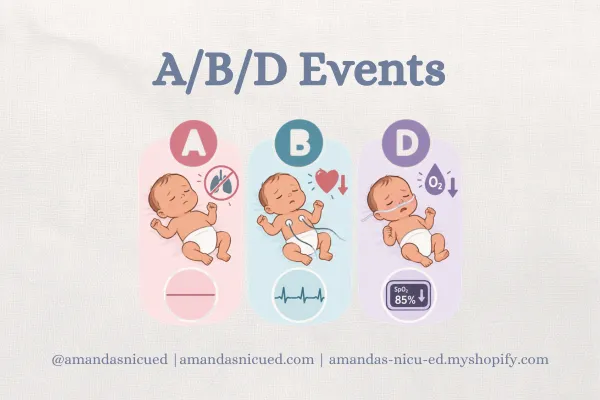
We call this an A/B/D event: apnea, bradycardia, desaturation. New nurses often treat those as three separate problems happening to show up at the same time. They're not. They're one event, and once you understand why they're connected, you stop chasing three numbers and start reading what the baby is actually doing.
First, what counts as apnea?
Not every pause in breathing is apnea of prematurity. The working definition most units use is a respiratory pause of 20 seconds or longer, or a shorter pause accompanied by bradycardia or desaturation. That second half matters. A 12-second pause in breathing with a heart rate that never budges is not the same clinical event as a 12-second pause that drags the heart rate into the 80s.
There's also a distinction in apnea type that changes what you do at the bedside:
Central apnea: no respiratory effort, no airflow. Chest still.
Obstructive apnea: the baby is trying to breathe, but something is blocking the airway. Chest is moving, air isn't.
Mixed apnea: both, usually central first, then an obstructive component as the baby tries to recover.
A baby with an obstructed airway and a moving chest needs repositioning, not just stimulation. If you only glance at the monitor and never look at the chest wall, you'll miss which one you're dealing with.
Why do preterm babies do this in the first place?
The brainstem regulates breathing rhythm using chemoreceptors that respond to oxygen and carbon dioxide levels, and in a preterm infant that control system is still developing. The younger the gestational age, the less mature and less consistent that system is, especially during sleep. A large narrative review on this exact topic lays out how that immaturity shows up as apnea, periodic breathing, and intermittent hypoxemia, all on a spectrum tied to gestational age (Erickson, Dobson, & Hunt, 2021).
Why does the oxygen saturation fall next?
When effective breathing stops, fresh air stops reaching the alveoli. Oxygen transfer into the blood drops. Preterm infants desaturate fast because they're working with a smaller margin to begin with: less oxygen reserve, higher oxygen consumption relative to size, and less stable lung volume.
Let's talk a little more about lung volume. Functional residual capacity, the air left in the lungs after you exhale, acts as an oxygen reservoir between breaths. A smaller reservoir means a breathing pause hits the oxygen saturation faster. Research measuring FRC directly in preterm infants found an inverse relationship between FRC and how quickly SpO2 fell during a breathing pause, meaning babies with lower lung volumes desaturated faster during the same length of apnea (Tourneux et al., 2008). Every time you're deciding whether a baby needs a little PEEP or a slightly different position to protect their lung volume, this is the physiology behind that decision.
So, why does the oxygen saturation fall? Because ineffective breathing leads to less oxygen entering the blood, which leads to falling saturation.
Why does the heart rate follow?
If oxygenation falls during the event, the infant may develop bradycardia. That is why we often see the three findings together: a breathing pause, then a fall in oxygenation, then a fall in heart rate.
Most bradycardias are associated with both an apneic pause and a desaturation. When all three occurred, the fall in oxygenation generally begins before the bradycardia.
So, why does the heart rate drop? Pauses in breathing lead to falling oxygenation, which may lead to a falling heart rate.
That word "may" is important. Not every pause causes a meaningful desaturation or bradycardia. Not every bradycardia starts with apnea.
Why doesn't the monitor always show that order?
Sometimes the heart rate alarm goes off before you see the saturation drop on the screen. That does not necessarily mean the heart rate changed first. Pulse oximeters display an averaged value calculated over a window of time, so the settings on your monitor affect how fast a real change actually shows up on the screen. Poor signal from a wiggly baby or a loose probe muddies this further.
There are also events that don't start with breathing at all. Airway obstruction can cut off airflow while the baby still looks like they're trying to breathe. And vagal stimulation, the kind you can get from a deep suction pass, a vagal response to reflux, or even just handling, can drop the heart rate fast without any apnea leading up to it. If you assume every bradycardia means the baby stopped breathing first, you'll miss the ones that didn't.
The order the alarms go off in is a clue. It is not a diagnosis. Go look at the baby.
What should you be assessing?
The monitor tells you something changed. Your assessment tells you what changed and what this particular baby needs right now.
Look at the baby first:
Is the chest moving? Is air actually moving?
What's the color, tone, and responsiveness?
Is head or airway position part of the problem?
Are the ECG tracing and pulse ox waveform even reliable right now, or is it artifact?
Then look at context:
Was this during sleep, during cares, during or right after a feed? Reflux-triggered events can be common in growing preemies.
Did the baby recover on their own, or need stimulation or respiratory support to come back?
Is this consistent with this baby's usual pattern, or does it look new?
Don't assume events are always due to apnea of prematurity. New, frequent, severe, or worsening events deserve a look at other contributors: infection, intracranial injury, anemia, thermal instability, or simply too much handling too close together.
This is also where caffeine fits into the picture. It's first-line prophylaxis for apnea of prematurity because it stimulates the respiratory center and improves chemoreceptor sensitivity, essentially waking up the part of the system that's still maturing. If a baby is on caffeine and still having frequent events, that's something to discuss with the team.
How do you explain this to parents?
You don't need to teach a family about chemoreceptors. Try something like:
"Since your baby was born early, the part of the brain that keeps breathing steady is still maturing. Sometimes there's a pause in breathing. When that happens, the oxygen level can drop, and the heart rate can slow down too. We watch closely for this and respond based on what your baby needs in the moment."
Then talk about this baby's event specifically: what you saw, what you did, how they recovered, and whether the team is tracking a change in the pattern. That specificity is what actually reassures a parent. "It's normal for preemies" doesn't.
In Summary,
Apnea, desaturation, and bradycardia show up together because breathing, oxygenation, and heart rate are physiologically wired to each other. The usual sequence is a breathing pause, then falling oxygenation, then a slowing heart rate. But it's not identical every time, and the exceptions (obstruction, vagal reflexes, monitor lag) are exactly why a solid assessment is so important. The monitor gives you numbers. Understanding the physiology, and actually looking at the baby, tells you what those numbers mean.
Want to get more comfortable connecting neonatal physiology to what you're seeing at the bedside, instead of just memorizing facts for the test? That's exactly what my RNC-NIC/CCRN-Neonatal certification review course is built to do. Check it out today!
References
Erickson, G., Dobson, N. R., & Hunt, C. E. (2021). Immature control of breathing and apnea of prematurity: The known and unknown. Journal of Perinatology, 41(9), 2111–2123. https://doi.org/10.1038/s41372-021-01010-z
Tourneux, P., Léké, A., Kongolo, G., Cardot, V., Dégrugilliers, L., Chardon, K., Storme, L., Krim, G., Libert, J. P., & Bach, V. (2008). Relationship between functional residual capacity and oxygen desaturation during short central apneic events during sleep in "late preterm" infants.Pediatric research,64(2), 171–176. https://doi.org/10.1203/PDR.0b013e318179951d

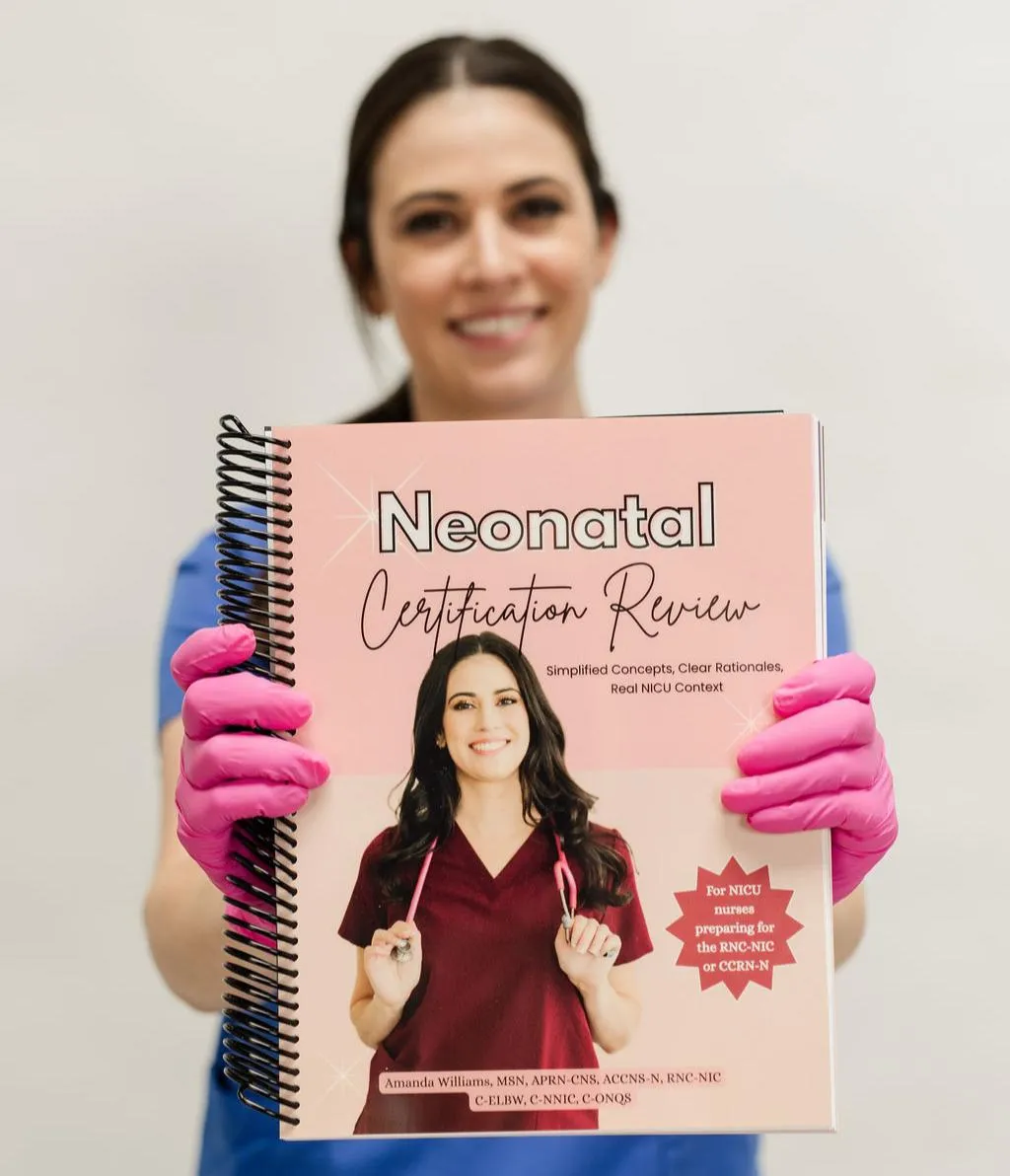
NEONATAL CERTIFICATION
REVIEW BOOK
📌 What’s Inside:
- 13 comprehensive chapters covering core NICU certification content
- Clear, organized breakdowns for fast recall
- Peer-reviewed to ensure clinical accuracy and depth
- Ideal for RNC-NIC or CCRN-N prep — or as a reference guide for NICU nurses at any level
- Plenty of space to write in and take notes
📚Table of Contents:
- Maternal Health & Birth History
- Intrauterine to Extrauterine Transition
- Neonatal Resuscitation
- Thermoregulation
- Neurologic System
- Respiratory System
- Oxygen, Ventilation, & Acid-Base Balance
- Cardiovascular System
- Nutrition & Feeding
- Hematopoietic System
- Infection & Immunology
- Professional Practice

Ready to kickstart your journey to becoming a certified NICU nurse?
Look no further!
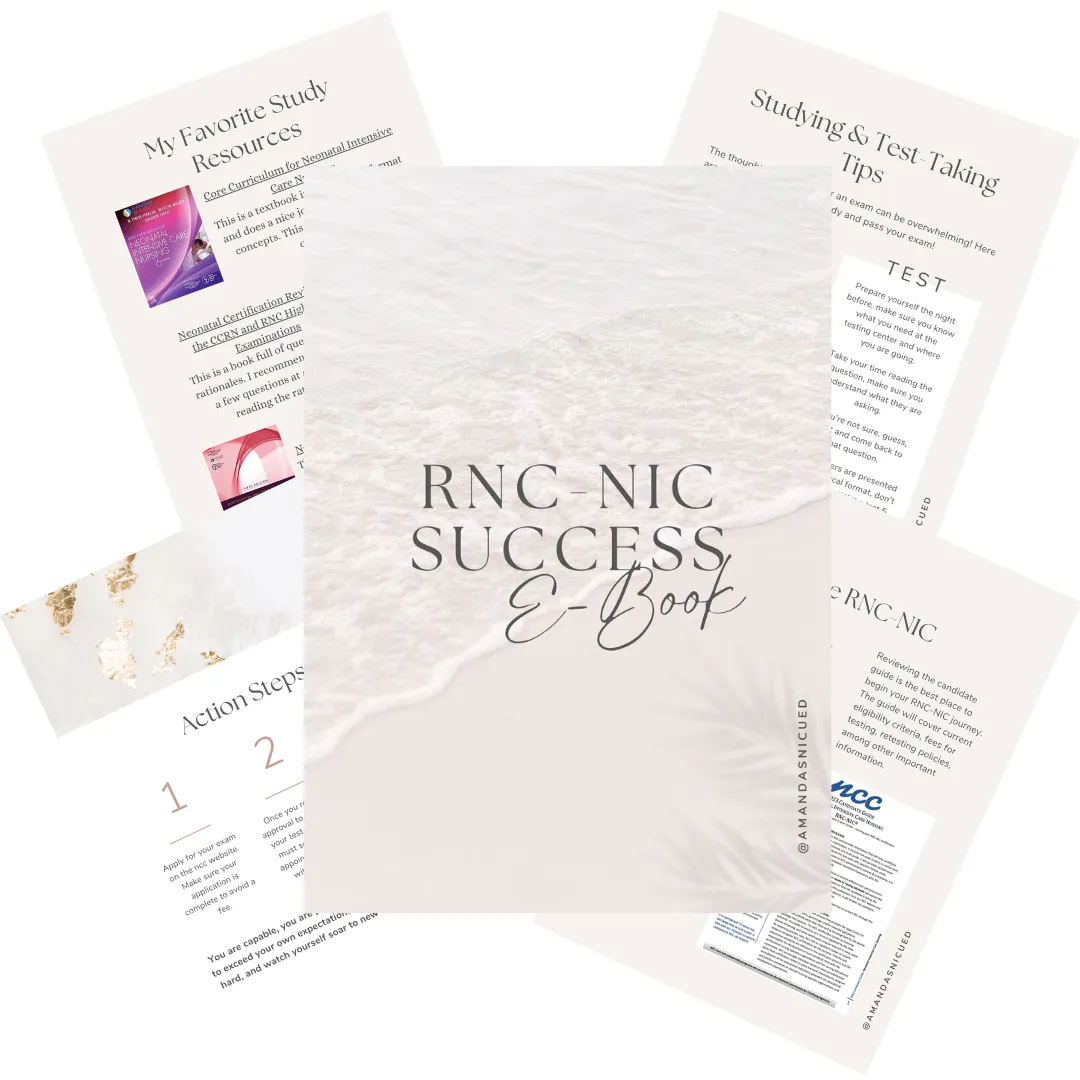
Grab my FREE E-Book packed with essential study and test-taking strategies for the RNC-NIC.
In the E-Book I give you the resources you need including the link to access the candidate guide, several types of books to study from, some of my favorite strategies, an outline of the content you should review, and a blank calendar for you to make your study plan!
Frequently Asked Questions About the RNC-NIC exam

What is the RNC-NIC?
The RNC-NIC is a competency-based exam that tests the specialty knowledge of nurses in the United States & Canada who care for critically ill newborns and their families.
The RNC-NICU is a nationally recognized certification that recognizes the registered nurse for their specialty knowledge and skill.
Who can take the RNC-NIC exam?
Nurses can take this exam after a minimum of two years experience in the NICU caring for critically ill newborns and their families.

Which books should I use?
I'm glad you asked! There are many excellent books to help you prepare for the RNC-NIC, I gathered ande describe each of them for you in my FREE e-book.
Is there a course to help me study?
Yes! Many hospitals host their own certification course and there are a few online courses. See my RNC-NIC test taking tips E Book for more information
What happens if I don't pass the exam?
If you don't pass the exam on your first try you can try again after 90 days. You will have to reapply after 90 days and pay a retest fee. There is no limit to the number of times you can take the exam (however a candidate can only sit for the exam twice per year).
Can I make more money if I take the RNC-NIC exam and get certified?
Yes! Many hospitals provide a raise or a bonus for nurses with specialty certifications. Hospitals also typically hire at a higher base salary when nurses have a certification.

Find me @amandasnicued on these channels or Email me
hey nurses don't miss out
© Copyright 2024. AmandasNICUEd. All rights reserved. | Terms & Conditions | Privacy Policy Contact: [email protected]