

Welcome to Amanda's NICU Education


Hi! My name is Amanda. I'm a NICU nurse, Clinical Nurse Specialist, NICU Educator... basically your NICU BFF. If you want to talk NICU, I'm here for you! I love everything about NICU nursing and I'm eager to learn and share my knowledge with all my NICU friends.
I have been a NICU nurse since 2009 I am currently a Clinical Nurse Specialist in a Level IV NICU in Los Angeles.
I am passionate about educating the next generation of NICU nurses. I share my knowledge through platforms such as Instagram and Facebook and am excited to have you here on my website!
Click on the button below to sign up for my newsletter filled with NICU education and tips for all experience levels.

Not very many people love taking tests but as a self-acclaimed "forever student" who has taken (and passed) five different certification exams I am no longer afraid of tests! "Way to brag", you might be thinking but I want to help YOU pass your certification exam too!
Introducing Amanda's RNC-NIC Success digital course - your ultimate study companion!
Gain unlimited, on-demand access for life, ensuring you're primed to ace your certification exam.
I'm here to help you succeed and I can't wait for you to share with me that you PASSED the RNC-NIC EXAM!!!



Inotropes & Vasopressors
As NICU nurses, it’s essential that we are knowledgeable about caring for both the most stableandthe most unstable infants. When I think about some of the sickest babies I’ve taken care of, many of them required inotropes and vasoconstrictors. These medications can feel intimidating and often take time to truly understand.
Let’s review them together. Whether you're encountering these medications for the first time or have years of experience managing them, understanding the nuanced differences in how these drugs work (especially in our vulnerable NICU population) directly impacts patient outcomes.
Before the Drips: Understanding Receptors
Before we dive into the drugs themselves, it’s important to review and understand thereceptorsthese medications act on.
Adrenergic receptorsare located throughout the body: in the heart, lungs, blood vessels, kidneys, nerves and more. When activated, they produce different physiologic responses. For example,dopaminergic receptors respond to dopamine, and their effects vary based ondoseandpatient population(preterm infants respond differently than term infants).

Dopaminergic Receptors
Increase renal and mesenteric blood flow
Alpha Receptors
α₁:Vasoconstriction and increased systemic vascular resistance (SVR)
α₂:Inhibits norepinephrine, acetylcholine, and insulin release
Beta Receptors
β₁:Increases heart rate (HR), contractility, and renin release
β₂:Vasodilation, relaxation of smooth muscle, bronchodilation, increased glucagon release, and glycogenolysis
Vasopressin (V) Receptors
V₁:Vasoconstriction and increased SVR
V₂:Water reabsorption (antidiuretic effect)
A helpful memory aid I’ve learned is:
“1” affects the heart(we have one heart)
think chronotropy, inotropy
“2” affects the lungs(we have two lungs)
think bronchodilation, smooth muscle relaxation
Of course, this doesn’t cover everything—but itisa useful starting framework.
Inotropes vs. Vasopressors: What’s the Difference?
Inotropesincrease cardiac contractility
Vasopressorsincrease peripheral vasoconstriction, which raises SVR
Many medications haveboth inotropic and vasoactive effects, which is why understanding physiology (not just blood pressure) is so important.
Let’s review the most commonly used agents.
Dopamine
Dopamine is one of the most commonly used and studied inotropes/vasopressors in the NICU. Its effects aredose-dependent.
Low Dose – Dopaminergic Receptors
Term infants:2–4 mcg/kg/min
Preterm infants:0.5–2 mcg/kg/min
Increases renal and mesenteric perfusion
Moderate Dose – β₁ Receptors
Term infants:5–10 mcg/kg/min
Preterm infants:2–6 mcg/kg/min
Increases inotropy (contractility) and chronotropy (HR)
May lose inotropic effect after ~8–12 hours due to depleted norepinephrine stores
High Dose – α₁ Receptors
Term infants:>10 mcg/kg/min
Preterm infants:5–15 mcg/kg/min
Peripheral vasoconstriction, increased SVR, glycogenolysis
Important consideration:
Premature infants haveimmature adrenergic receptor regulation, which means they may demonstrateincreased alpha activity at lower dosescompared to term infants.
Clinical Pearl:In very sick or premature infants, the norepinephrine stores can be depleted in as little as8–12 hours. If you find yourself constantly needing to increase the dose to maintain the same BP. The baby may have hit a ceiling, and it might be time to suggest a direct-acting agent like Epinephrine.
Adverse Effects of Dopamine
Tachycardia
Hyperglycemia
Tissue ischemia
Decreased endocrine function
Hypothyroxinemia of prematurity
Increased pulmonary vascular resistance (PVR)
⚠️Avoid dopamine in infants with PPHN, as it may worsen pulmonary hypertension.
Interestingly, this same effect can make dopamine helpful in cases of ahemodynamically significant PDA.
Dobutamine
Dobutamine is a commonly used inotrope for treatinghypoperfusion due to myocardial insufficiency or elevated PVR. It is often preferred in patients withpoor myocardial contractility and normal SVR. One important consideration is that dobutamineincreases myocardial oxygen demand.
Dosing and Effects
Low Dose – β₁ and β₂ Receptors
<5 mcg/kg/min
Increases HR, contractility, and stroke volume
Higher Dose – α₁ Effects
5–15 mcg/kg/min
Increased peripheral vasoconstriction and SVR
Dobutamine increases intracellular calcium, which drives increased contractility, HR, and stroke volume.
Adverse Effects to Monitor
Tachycardia
Increased urine output
Electrolyte imbalances
Increased myocardial oxygen demand
Learn more in my Shock & Vasoactive Drugs Mini Course
Epinephrine
Epinephrine (adrenaline) is anendogenous catecholamineproduced by the adrenal glands and is a powerful inotropeandvasopressor.
Atlow doses, epinephrine can act similarly to dobutamine by augmenting myocardial function.
Low Dose – β₁ and β₂ Receptors
0.01–0.1 mcg/kg/min
Increased HR, contractility, lusitropy, and coronary artery dilation
Decreased SVR
High Dose – α₁ and α₂ Receptors
0.1 mcg/kg/min
Increased peripheral vasoconstriction and SVR
Coronary vasoconstriction
Adverse Effects
Tachycardia
Hyperglycemia
Lactic acidosis
Hypokalemia
Myocardial ischemia
Peripheral ischemia and limb necrosis
Norepinephrine
Norepinephrine is another endogenous catecholamine that primarily affectsvascular tone and blood pressure. It preferentially causessystemic vasoconstriction over pulmonary vasoconstriction, making it useful in distributive shock (like septic shock) states.
Dosing
Initiation: 0.05–0.1 mcg/kg/min
Maximum: 2 mcg/kg/min
Receptor Activity
α₁ and α₂ stimulation
Minimal β₂ activity
Because of this profile, norepinephrine tends to causefewer metabolic side effects(like hyperglycemia and lactic acidosis) compared to epinephrine.
Adverse Effects to Monitor
Tachycardia
Peripheral ischemia
Acidosis (especially at higher doses)
Vasopressin
Vasopressin is anendogenous neuropeptide, also known asantidiuretic hormone (ADH). It plays a key role in osmolarity and fluid homeostasis and is often used when hypotension persists despite inotropes, vasopressors, or steroids.
Dosing
0.01–0.12 units/kg/hr
Receptor Activity
V₁a:Vasoconstriction and increased SVR
V₂:Water reabsorption and increased plasma volume
Because vasopressin has antidiuretic effects,decreased urine outputis expected.
Adverse Effects
Thrombocytopenia
Elevated liver enzymes
Hyponatremia
Cutaneous ischemia and necrosis
Milrinone
Lastly, let’s talk aboutmilrinone(even though it’s not technically an inotrope or a vasopressor… and neither was vasopressin 😉).
Milrinone is aphosphodiesterase-3 inhibitorthat prevents the breakdown of cAMP and cGMP, leading tovasodilation and improved myocardial relaxation and contractility. It also provides lusitropy (diastolic relaxation), enhancing LV filling.
One major advantage of milrinone is that itdoes not increase myocardial oxygen demand, making it ideal for infants with congenital heart disease, especially post-operatively.
Loading doses may be used but should be administeredslowly (over 1–3 hours)to prevent hypotension.
Adverse Effects
Hypotension (highest risk during initiation or with low intravascular volume)
Tachycardia
Arrhythmias
Thrombocytopenia
Back to Basics: Nursing Considerations for Managing Drips
When caring for infants receiving inotropes and vasoactive medications, some “basic” nursing considerations are critical:
Alwaysdouble-check the dose and rate with another RN
These medications are given ascontinuous infusions
If a drug is discontinued,do not rapidly flush the lumenit was infusing through (this can cause an unintended bolus)
Monitor the infusion site closely—many of these drugs can causeischemia or necrosiswith extravasation
Ideally, administer via acentral line; if not available, monitor peripheral sites extremely closely
Useinline filterswhen indicated to prevent air embolism, precipitates, or bacterial contamination
If unsure whether a medication requires a filter,check the package insert or contact pharmacy
Always follow yourinstitutional policies
Remember: These medications require both knowledge and experience. New nurses - don't hesitate to ask questions. Experienced nurses - your insights during bedside teaching moments are invaluable for growing our next generation of NICU nurses.
Let’s do a case study:
The Scenario:
You are caring for Baby Sofia, a 24-weeker on Day of Life 3. She has a confirmed E. coli positive blood culture. She is intubated and requires increasing support. Despite a normal saline bolus, her MAPs are 22 mmHg (her gestational age is 24).
Current Status:
Medication:Dopamine is infusing at 10 mcg/kg/min.
Assessment:She is tachycardic (HR 185), her pulses are weak, and her lactic acid is climbing (4.2 mmol/L).
The team wants to increase the Dopamine to 15 or 20 mcg/kg/min to get her pressures up.
Based on the physiology of a 24-weeker, why might the nurse suggest stopping the Dopamine titration and switching to Epinephrine instead?
A) Dopamine causes significant sedation in micro-preemies, making it hard to assess their neuro status.
B) Preterm infants have immature receptors and may have depleted their norepinephrine stores, making "direct-acting" Epinephrine more effective.
C) Epinephrine is the only medication that can be safely given through a peripheral IV in an emergency.
The Answer: B
As we discussed in the "Dopamine" section, Dopamine is an indirect-acting catecholamine. It works by telling the baby's brain/adrenals to release their own stored norepinephrine.
A 24-weeker on Day 3 is physiologically fragile. She likely doesn't have much norepinephrine stored up. If you keep cranking the Dopamine up, you're eventually going to deplete the stores of norepinephrine.
Epinephrine is direct-acting. It doesn't make the adrenals release catecholamines; it hits the alpha and beta receptors directly.
Nursing Pearl:When you make this switch, watch the Blood Glucose. Epinephrine can cause hyperglycemia because it tells the liver to dump glucose for energy. Don't be surprised if you need to adjust your dextrose infusion or start frequent glucose checks.
Shock & Vasoactive Drugs Minicourse
If you found this interesting and want to go deeper intoinotropes, vasopressors, and shock physiology, check out myShock & Vasoactive Drugs online minicourse.

What questions do you have about these drugs? Ask away! I love hearing from you.
Stay curious,
Amanda
© 2025 This content is for educational purposes and should complement, not replace, your unit's policies and procedures.
Missed my other newsletters? Click here to read them!
Reference:
Beaulieu, M. J. (2013). Vasopressin for the treatment of neonatal hypotension.Neonatal Network,32(3), 209–212.https://doi.org/10.1891/0730-0832.32.3.209
Hébert, A., Ford, S., Lakshminrusimha, S., Rios, D. R., Bhombal, S., Moore, S. S., & Altit, G. (2025). Physiology-guided vasoactive therapy in neonates: Rethinking dopamine as first-line.Journal of Perinatology. Advance online publication.https://doi.org/10.1038/s41372-025-02407-w
Jnah, A. J., Barnes, J., & Dias, P. L. (2026). Hypotension and shock. In A. J. Jnah (Ed.),Neonatal pharmacology: A case-based approach(pp. 401–448). [Publisher Name—Note: Usually National Association of Neonatal Nurses or similar].
Odackal, N. J., Crume, M., Naik, T., & Stiver, C. (2024). Cardiac development and related clinical considerations.NeoReviews,25(7), e401–e414.https://doi.org/10.1542/neo.25-7-e401
Schmaltz, C. (2009). Hypotension and shock in the preterm neonate.Advances in Neonatal Care,9(4), 156–163.https://doi.org/10.1097/ANC.0b013e3181af5388



December 2023 Certification Review Webinar
NICU Certification Review

Ready to kickstart your journey to becoming a certified NICU nurse?
Look no further!
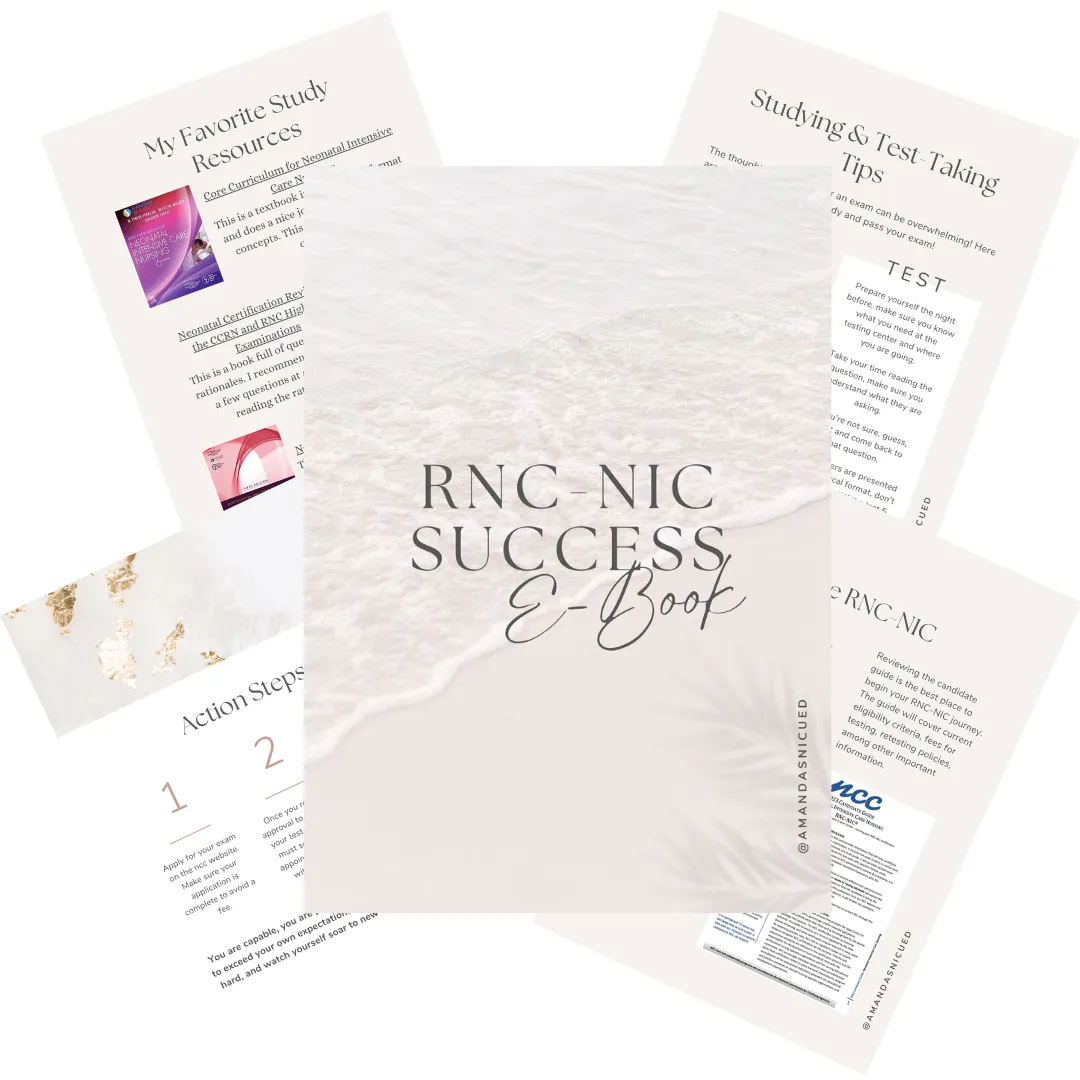
Grab my FREE E-Book packed with essential study and test-taking strategies for the RNC-NIC.
In the E-Book I give you the resources you need including the link to access the candidate guide, several types of books to study from, some of my favorite strategies, an outline of the content you should review, and a blank calendar for you to make your study plan!
Frequently Asked Questions About the RNC-NIC exam

What is the RNC-NIC?
The RNC-NIC is a competency-based exam that tests the specialty knowledge of nurses in the United States & Canada who care for critically ill newborns and their families.
The RNC-NICU is a nationally recognized certification that recognizes the registered nurse for their specialty knowledge and skill.

Who can take the RNC-NIC exam?
Nurses can take this exam after a minimum of two years experience in the NICU caring for critically ill newborns and their families.

Which books should I use?
I'm glad you asked! There are many excellent books to help you prepare for the RNC-NIC, I gathered ande describe each of them for you in my FREE e-book.
Is there a course to help me study?
Yes! Many hospitals host their own certification course and there are a few online courses. See my RNC-NIC test taking tips E Book for more information
What happens if I don't pass the exam?
If you don't pass the exam on your first try you can try again after 90 days. You will have to reapply after 90 days and pay a retest fee. There is no limit to the number of times you can take the exam (however a candidate can only sit for the exam twice per year).
Can I make more money if I take the RNC-NIC exam and get certified?
Yes! Many hospitals provide a raise or a bonus for nurses with specialty certifications. Hospitals also typically hire at a higher base salary when nurses have a certification.

Find me @amandasnicued on these channels or Email me
hey nurses don't miss out
© Copyright 2024. AmandasNICUEd. All rights reserved. | Terms & Conditions | Privacy Policy Contact: [email protected]